
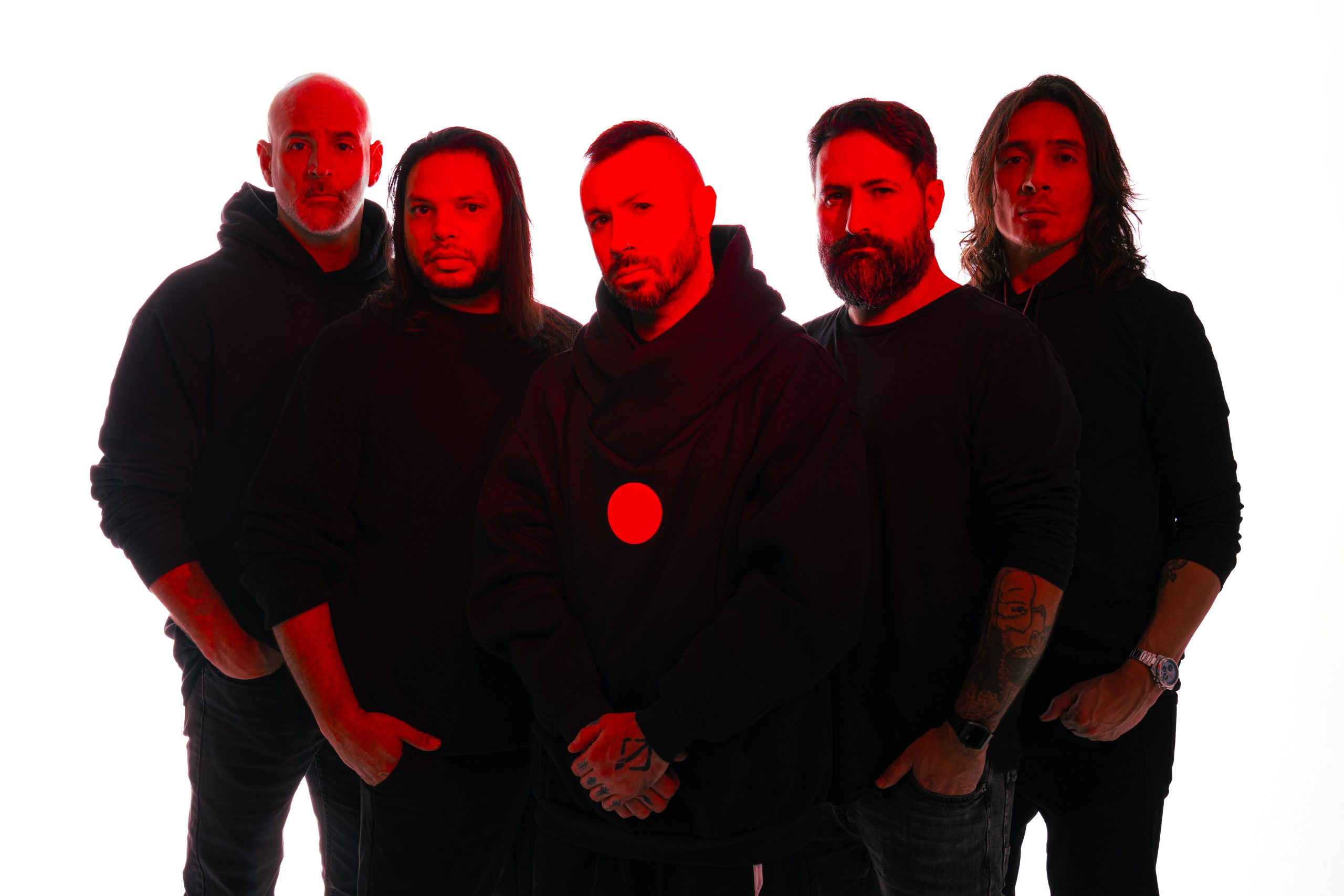
Rebirth takes work. Just ask Periphery. The GRAMMY® Award-nominated quintet—Misha Mansoor [guitar, programming], Jake Bowen [guitar, programming], Matt Halpern [drums], Spencer Sotelo [vocals], and Mark Holcomb [guitar]—has quietly, yet diligently reshaped, recharged, and redefined itself over the course of nearly two decades as a unit. The band’s signature sound has evolved like any living and breathing organism would, gaining complexity and strength through life experience. Such progression has enabled the collective to deliver its most cohesive offering yet, A Pale White Dot [3 DOT RECORDS].
Once again, you can expect Periphery’s trademark mind-blowing instrumentation, immersive soundscape architecture, cathartically crushing vocals, and cosmically catchy melodies, but you’ll also get emotional acuity, raw humanity, and a level of relatability that could only come from a group of brothers who have effectively gone through it all…
“As this orientation of Periphery, we’ve been together for a long time,” Matt affirms. “We’ve learned how to work with one another and support each other. Like any relationship, there have been ups and downs. We’ve figured out how to operate, and we’re all on the same wavelength. A Pale White Dot is the culmination of all of that. In every aspect, we created this together. The goal is to continue forward from here, so the album is a new beginning for us.”
Periphery has charged ahead at lightspeed since the 2010 release of their self-titled debut LP. Along the way, they picked up a GRAMMY® Award nomination for “Best Metal Performance,” notched three straight Top 25 debuts on the Billboard 200, clocked hundreds of millions of streams, and sold out shows on multiple continents. 2023’s Periphery V: Djent Is Not a Genre elevated them to another stratosphere. Inciting global tastemaker praise, it received perfect scores of “5-out-of-5” from New Noise Magazine and MetalSucks, while RIFF marveled at how, “it’s nearly impossible to pin down.” KERRANG! hailed it as “an extravagant, unequivocal statement,”and Revolver summed it up best, “The record slams.” Beyond touring with the likes of Coheed and Cambria and Mastodon, they notably played to their biggest crowds yet as a headliner. Returning home, the five-piece chose to approach what would become A Pale White Dot with a thematic framework in mind.
“We aimed to create with more intention this time,” notes Matt. “We didn’t intend to make a concept record, but we did want to follow a theme. Instead of telling a core story, the plan was to adhere to an overarching motif and create within this box. The main idea was loneliness. I thought, ‘I have a wonderful family as well as my band who are my best friends, but there are things I’m dealing with internally that make me feel very lonely’. Misha and I were talking, and the conversation led to identifying loneliness as the theme. He wasn’t the only one who related; the other guys did too. We came up with twelve different representations of either personal examples of loneliness or fictional ideology that we channeled into the songs—which we’d never done before.”
“From 2020 until 2022, everybody dealt with loneliness,” adds Spencer. “Personally, I was going through a divorce. There was a lot of turmoil. I definitely injected my feelings into some of the tracks.”
Marking another first, the musicians opted to work on all of the songs face-to-face in the same space, whether it be at Misha’s studio in Los Angeles or on the road. This choice infused a surge of electricity into the LP’s genesis as they self-produced and assembled this offering in secret. “All five of us had to be in the room,” Matt reiterates. “On previous projects, there was remote writing. For this one, we did everything together.”
“It’s actually pretty funny that the most collaborative record we’ve ever made is about loneliness,” smiles Spencer.
They ignite this era with the incendiary single “Mr. God.” Broken up by stilted pam-muting, a caustic riff rattles the senses, stomping along deliberately at a hulking chug. Spencer’s venomous vocals cut through the ominous beat, glitchy electronics, and airy textures. As if chewing through the feedback, he repeatedly screeches, “Burn out.”
“We had an idea for a fictional character with the ability to burn everything down,” says Matt. “We pulled inspiration from mythology. We talked about the ‘god of fire’ and how it must’ve been such a lonely existence for him.”
Spencer elaborates, “To dive deeper, you can think of it as someone with a god complex who is figuratively burning everything down.”
Co-written by Beartooth’s Caleb Shomo, “Everyone Dies Alone” codifies the central mission statement. A sturdy beat anchors the track until warbling clean vocals hover from the ether of spacey keys. The mood flips on a dime, distortion kicks into overdrive, and the frontman demands, “Give me all your pain…my never-ending rage is gonna take it all away.” It culminates on a moment acceptance, “The world keeps breathing, but everyone dies alone,” capped off by an emotionally charged solo.
“We’ve all experienced the loss of a loved one,” notes Matt. “Most recently, my father-in-law passed away. Mark lost his dad. We wondered, ‘What is the experience like for a person who’s dying even if there are people around? What happens after death? What’s it like leading up to it?’ Caleb helped us come up with a succinct direction lyrically and melodically.”
Then, there’s “Heaven On High.” Strains of strings dissolve into a frenetically picked arpeggio. Spencer’s voice gets swept up in the undertow of a divinely heavy groove as he urges, “Break away from the roots before the storm comes for you.”
“You’re looking back on times when you weren’t the person you are today,” Matt remarks. “We all went through challenges as kids, whether it be bullying or not feeling accepted. We’ve gotten to where we are, and we love what we do. It’s the transition from ‘bad lonely’ to ‘good lonely’.”
Fortified by fast-paced riffing, a pounding rhythm sets the tempo for “Talk.” Screams give way to an instantly infectious refrain, “They say to take it day by day, giving yourself some time and grace.”
“We’ve all struggled with our mental health at times – some of us more than others.” “There can be moments when you feel anxious, scared, or worried, and it’s lonely. What you worry about can sometimes feel like it doesn’t matter the same way to anybody else. When you express your feelings to a friend or family member, they’ll say, ‘It’s going to be okay’. They get to walk away and go about their lives though. You’re stuck in your thoughts.”
The instrumental closer “A Pale White Dot” provides an exhale. Delicately plucked acoustic guitar serves as a plaintive and poetic coda. “It’s such a heavy and dark record, but this cleans the slate,” Spencer observes.
By connecting with each other, Periphery connect with listeners more than ever.
“I’ve always connected to music when I needed it in my life,” Matt leaves off. “We were very honest and intentional with this record. Each of us has a different bond to the music, but we’re all bound to it. It’s what Periphery is now.”
“The record breathes new life into Periphery,” concludes Spencer. “I’ve never been more stoked to be in this band with my friends.”